
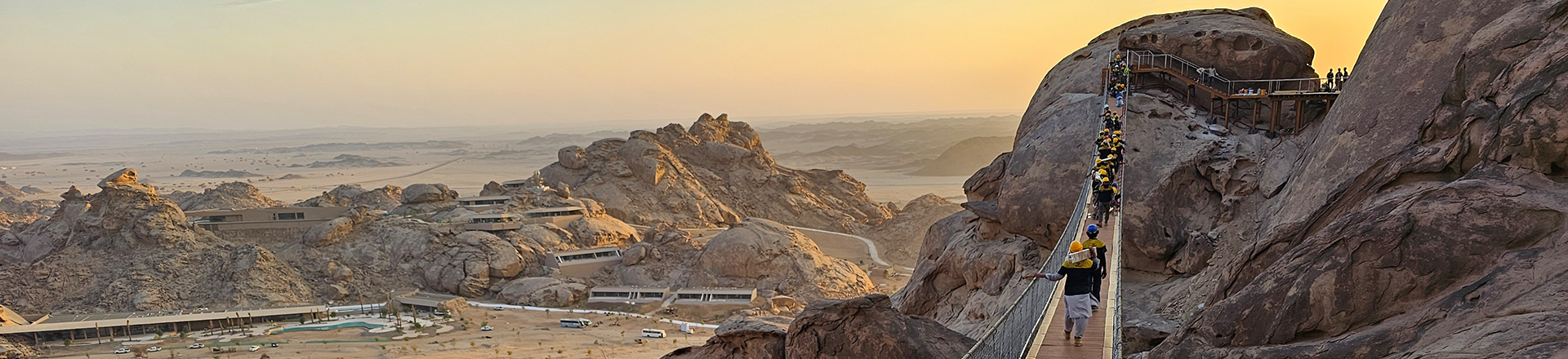
The most commercially valuable adventure destinations in the world share a common characteristic. They occupy terrain that most contractors cannot build on.
Cliffsides, canyon crossings, high-relief ridgelines, and remote mountain plateaus create the visual drama that lifts an adventure destination from a park attraction into a signature experience, and they command the premium ticket pricing that follows. The trade-off is that this terrain punishes weak engineering, inadequate logistics, and inexperienced construction management, often catastrophically.
The Hajar Mountains in the UAE and northern Oman, and the Sarawat range in western Saudi Arabia, offer some of the most compelling mountain terrain available for commercial adventure development anywhere in the world. Activating this terrain commercially requires a specialised discipline that combines geotechnical engineering, high-angle construction methodology, and logistical planning of a kind that most general contractors cannot deliver. This article examines what mountain adventure construction actually requires, and what separates successful projects from expensive lessons.
Overcoming the Logistical Challenges of Mountain Adventure Park Construction
Mountain construction begins with logistics, and logistics begin long before the first structural component leaves the workshop. Remote and steep sites are typically inaccessible to standard construction vehicles, which means every heavy element, structural steel, concrete for anchor foundations, cable spools, timber, and temporary works materials, has to be delivered by non-conventional methods. Contractors who underestimate this reality face immediate schedule collapse and budget escalation.

The primary logistical tools used on mountain adventure projects include helicopter-assisted material delivery, temporary aerial cableways, and specialised low-ground-pressure tracked vehicles. Each of these methods carries specific engineering requirements. Helicopter operations require pre-planned load rigging, certified lifting equipment, and coordination with civil aviation authorities. Temporary cableways require their own structural anchoring, load calculations, and safety protocols. Tracked vehicles capable of operating on steep gradients are specialist equipment with limited availability in the region, which means their scheduling has to be planned into the project programme from day one.
The second logistical dimension is workforce access. Construction teams working at elevation and on exposed cliffsides must be certified in high-angle work, rope access, and mountain rescue. Standard construction site safety protocols do not cover the specific hazards of mountain environments, and the applicable framework aligns with rope access industry standards such as IRATA and specific national civil defence requirements for high-consequence work.
The third logistical dimension is environmental sensitivity. Mountain terrain typically contains fragile ecosystems, seasonal water courses, and geological features that must be preserved during construction. This constrains where temporary works can be located, which construction methods are permissible, and how spoil and construction waste are managed. Contractors who fail to plan for these constraints face regulatory intervention and reputational damage.
Advanced Anchoring and Structural Engineering for Rugged Terrain
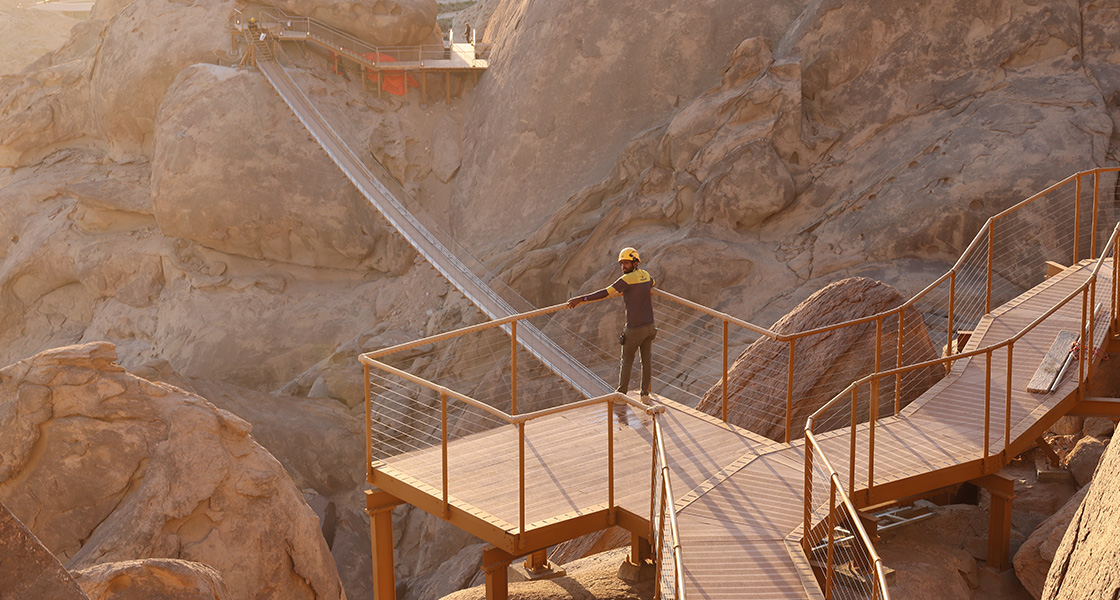
The safety and durability of every mountain adventure attraction is determined by the quality of its structural anchoring. Cliffside ziplines, suspension bridges, via ferrata routes, and cantilevered viewing platforms all transfer their loads into the rock face, and the integrity of that transfer is what stands between a functioning attraction and a serious incident.

Anchor design begins with geotechnical investigation. Competent design cannot proceed without direct testing of the host rock, including compressive strength analysis, joint pattern mapping, and identification of any weathering, fracture zones, or unstable material that would compromise anchor performance. In the Hajar and Sarawat ranges, the underlying geology varies significantly between sites, ranging from competent limestone and sandstone through to fractured and weathered zones that require specific engineering responses. A generic anchor specification applied without site-specific testing is a fundamental engineering failure.
Once the geotechnical baseline is established, the anchor system is designed around the specific loads the attraction will impose. Post-tensioned rock bolts, drilled to depths calculated from the design pull-out load and grouted with high-performance resin or cementitious systems, provide the primary structural connection to the host rock. Secondary redundancy is engineered independently, so that failure of any single anchor point cannot cause loss of the attraction. This redundancy principle is central to EN 15567-1 compliance and to insurance underwriting for high-consequence attractions.
Cable spans across canyons and valleys introduce additional engineering complexity. Long-span ziplines, suspension bridges, and highline walking installations all experience dynamic loading from riders, wind, and thermal expansion. The engineering must account for the full envelope of these forces, and the structural elements must be sized with fatigue life calculations appropriate to the design working life of the attraction.
Managing the Regional Climate
Mountain sites in the region present a specific climate challenge that flatland construction does not encounter. Daytime temperatures in summer can be extreme, particularly at exposed cliff faces where solar gain is amplified. Nighttime temperatures at elevation can fall sharply. The differential drives thermal cycling that stresses structural steel, cable systems, and any composite materials. Design must accommodate this cycling through appropriate expansion joints, cable pre-tensioning strategies, and material selection that maintains performance across the operating temperature range.
Seasonal weather also matters. Winter storms in the Hajar and Sarawat ranges can drive significant rainfall, flash flooding in wadis, and rare but real snow events at higher elevations. Structural design must accommodate wind loading appropriate to exposed ridgelines, and drainage strategy at anchor points and platform bases must prevent water infiltration that would degrade the anchor grout or corrode structural connections.
Weather also affects construction scheduling. Certain construction activities, including helicopter lifts, cable installation, and high-angle rope access work, are weather-dependent and cannot be forced against unsuitable conditions. A realistic project programme builds in weather contingency and sequences weather-sensitive work into the most reliable months, which is a form of scheduling discipline that inexperienced contractors consistently underestimate.
Turning Mountain Terrain into a Commercial Asset
The commercial reward for engineering mountain terrain correctly is substantial. Cliffside ziplines and via ferrata routes command premium ticket pricing precisely because the setting cannot be replicated on flat ground. Suspension bridges across dramatic canyons become signature attractions that anchor entire destination brands. Integrated eco-glamping and mountain hospitality built alongside adventure attractions produce the length-of-stay economics that transform capital returns.
The commercial risk of engineering mountain terrain incorrectly is equally substantial. Structural failure at height carries consequences that no operator can absorb, and reputational damage extends across an entire destination portfolio rather than a single attraction. This asymmetry is why sophisticated developers treat contractor selection on mountain projects as the single most important commercial decision in the programme.
Partner with the Region’s Mountain Adventure Construction Specialists
Developing adventure attractions in rugged mountain terrain is an extreme engineering discipline. Geotechnical investigation, structural design, high-angle construction, specialist logistics, and climate-adapted engineering all have to converge under a single project team with genuine experience in the specific conditions of the regional mountain environment. Few contractors in the region can deliver across all of these disciplines. Learn more about our approach on our Construction division page.
Our team combines structural engineers, geotechnical specialists, extreme terrain team and adventure attraction designers, working under a single project management framework aligned to EN 15567-1 and international safety standards.
Contact The Warrior Group’s Specialised Construction Division to discuss your mountain adventure project, review site feasibility, or explore how we can help you unlock the commercial potential of your rugged terrain.